Khandvi Recipe
Silky besan-and-yogurt ribbons rolled thin and dressed with fragrant tempering.
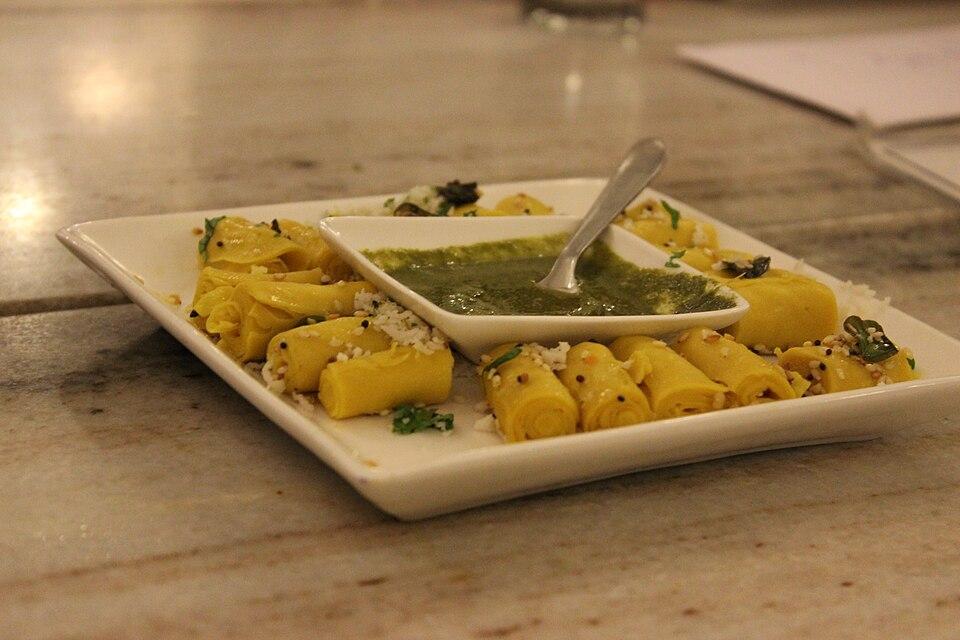
Photo: Shubhamj29 · CC BY-SA 4.0 · Resized
About this dish
Khandvi is a delicate Gujarati farsan made by cooking chickpea flour with a sour dairy liquid. It is a familiar offering at Ahmedabad farsan counters and in festive home spreads, although it is not confined to one city. Its appeal lies in soft, thin layers rather than a fried crunch. The closely related Maharashtrian preparation is known as suralichi vadi.
Ingredients
Batter
- 120 g fine besan (approximately 1 cup)
- 240 g plain sour yogurt (1 cup), whisked smooth
- 480 ml water (2 cups)
- 5 g ginger (1 teaspoon finely grated)
- 3 g green chilli (1 teaspoon finely minced)
- 0.5 g ground turmeric (¼ teaspoon)
- 4 g fine salt (approximately ⅔ teaspoon)
Tempering and garnish
- 20 ml neutral oil (1 tablespoon + 1 teaspoon)
- 3 g black mustard seeds (1 teaspoon)
- 3 g white sesame seeds (1 teaspoon)
- 1 g curry leaves (10–12 leaves)
- 0.2 g asafoetida (⅛ teaspoon)
- 6 g green chillies (2 small), slit
- 20 g freshly grated coconut (¼ cup)
- 15 g fresh coriander (¼ cup loosely packed), finely chopped
Method
- 1
Set up spreading surfaces
Arrange three clean, dry stainless-steel trays with a combined usable area of roughly 2,000–2,500 square centimetres. Their flat undersides can also be used, provided they are spotlessly clean and stable. Keep them at room temperature and place a broad metal spatula nearby before turning on the stove.
- 2
Blend the batter
Whisk the besan, yogurt, water, turmeric, and salt together off the heat for 2 minutes. Add the ginger and chilli and blend briefly until completely smooth. The uncooked mixture should be thin, with no visible flour lumps.
- 3
Strain for smoothness
Pass the batter through a fine sieve into a heavy, wide saucepan. Press gently for 1–2 minutes to extract the liquid, leaving coarse ginger or chilli fibres behind. Keep the pan off the heat until the spreading surfaces are fully ready.
- 4
Begin cooking
Place the pan over medium-low heat and stir continuously with a whisk for 4–5 minutes. Scrape the base and corners as the mixture changes from liquid to a smooth, thick cream. Lower the heat if it begins to catch or form stubborn lumps.
- 5
Develop the cooked paste
Continue stirring over low heat for another 5–8 minutes, switching to a firm spatula as the batter thickens. The paste should become glossy and form broad folds that briefly hold their shape. It should smell cooked and nutty, without the grassy aroma of raw besan.
- 6
Test before spreading
Spread a teaspoonful very thinly on a spare part of a tray and let it cool for 1 minute. Keep the pan over the lowest heat, stirring while the sample sets, then try lifting and rolling the sample. If it smears rather than rolls, cook for another 1–2 minutes and repeat the test.
- 7
Spread thinly and quickly
Remove the pan from the heat as soon as the test strip rolls cleanly. Immediately divide the hot paste among the trays and spread into thin, even sheets, approximately 1–2 mm thick. Work within 2–3 minutes because the paste becomes difficult to spread as it cools.
- 8
Cut and roll
Leave the sheets at room temperature for 4–5 minutes, until set but still supple. Cut into strips about 4–5 cm wide and 12–15 cm long. Lift one short edge with a knife and roll each strip gently into a loose coil without squeezing.
- 9
Temper and dress
Heat the oil over medium heat for 1 minute, then add mustard seeds and allow them to pop. Add sesame seeds, curry leaves, asafoetida, and slit chillies, and cook for 30–45 seconds until aromatic. Spoon over the arranged rolls and finish with coconut and coriander before serving warm or at room temperature.
Notes & variations
- Cup measures use a 240 ml cup; use ordinary plain yogurt rather than thick strained yogurt.
- Clean steel generally needs no greasing; excess oil makes it harder to spread a uniform sheet.
- The roll test is more dependable than a fixed cooking time because pan width and yogurt thickness vary.
- Refrigerate within 2 hours and eat within 2 days; let chilled rolls stand briefly before serving.
Serve with
Mild coriander chutney and chai, or alongside other farsan in a Gujarati thali.
Cook's note
Have every tray ready before cooking: properly cooked khandvi paste gives you only a short spreading window.